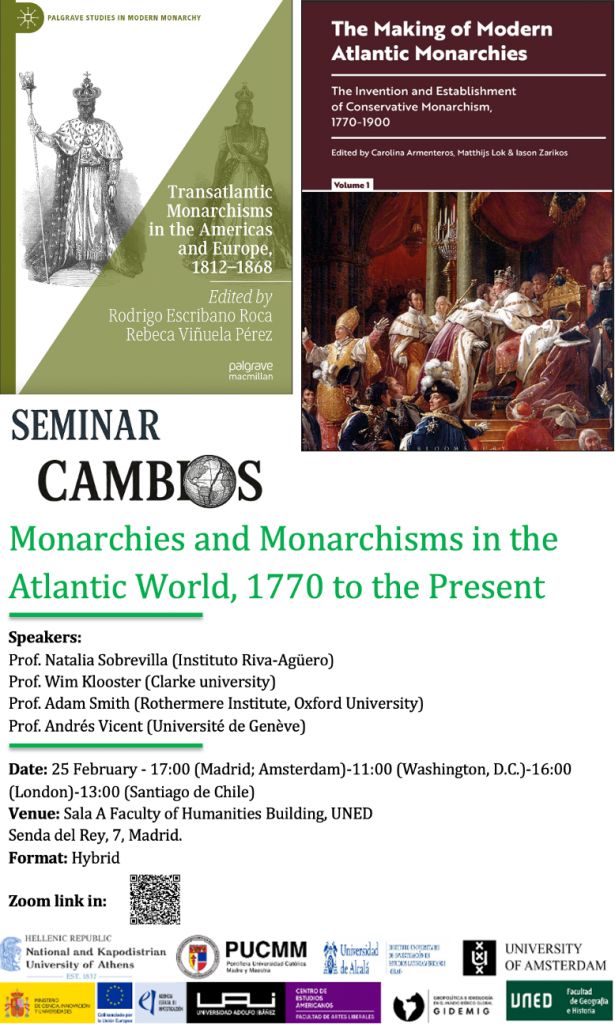
The seminar Monarchies and Monarchisms in the Atlantic World, 1770 to the Present offered a forum for debate on the historical evolution of monarchies and, centrally, on monarchism as a transnational political ideology in the Atlantic world from the age of revolutions to the present. Through the presentation and discussion of two recently published volumes—Making of Modern Atlantic Monarchies (Bloomsbury) and Transatlantic Monarchisms in the Americas and Europe (1812-1868) (Springer)—the seminar analysed the capacity of monarchies to adapt in contexts of imperial collapse, constitutional experimentation, and the formation of new political orders.
The seminar brought together Professor Natalia Sobrevilla (Instituto Riva-Agüero), Professor Wim Klooster (Clarke University), Professor Adam Smith (Rothermere Institute, University of Oxford), and Professor Andrés Vicent (Université de Genève), whose contributions will offer comparative and long-term perspectives. The event aims to foster transnational and interdisciplinary dialogue on one of the most persistent and repeatedly reconfigured political traditions of Atlantic modernity.
Seminar Cambios (Session 3) — Web Minutes (Essayistic Summary)
The third session of the Cambios Seminar unfolded as a deliberately hybrid encounter—anchored in Madrid but spanning multiple time zones—devoted to the simultaneous launch of two major book projects on monarchy and monarchism in the modern Atlantic world. Edward Jones Corredera acted as moderator of the session, overseeing the flow of interventions and discussion, while Eduardo oversaw the practical running order of the ceremony and seminar. The convenors emphasised from the outset the need to keep the discussion focused, given the unusually large number of speakers. The audience was also invited to follow the next session of the series, devoted to colonial pasts, justice, and reparations.
Institutional welcome and framing
Ángeles Lario, Vice-Dean for Quality and Innovation, opened with an institutional and intellectual welcome. Speaking both as a faculty authority and as a scholar long engaged with the topic, she underscored the renewed scholarly vitality of monarchy studies—now enriched by approaches ranging from court studies and symbolic representation to political and institutional history. She welcomed the gathering as an opportunity to advance a field whose relevance, in her view, remains central to understanding the design of contemporary state models in Europe and their historical resonance in the Americas. Her remarks also located the session within a broader academic ecology: publishing networks, ongoing research agendas, and the conviction that monarchy continues to matter as an analytical problem rather than as an antiquarian survival.
Opening the transatlantic conversation
Matthijs Lok then took the floor as chair, greeting participants across Europe, the Americas, and beyond, and highlighting the rare circumstance that two substantial works on closely related problems had appeared at the same historical moment. He suggested that this convergence was more than accidental: contemporary politics has revived public disputes about monarchy—both in conventional settings and in unexpected “neo-monarchical” idioms circulating in technological and reactionary imaginaries—making it all the more urgent for historians to provide critical illumination. He introduced the structure of the session: first, a presentation of the Palgrave volume by Rodrigo Escribano Roca and Rebeca Viñuela Pérez; second, a presentation of the Bloomsbury volumes by Carolina Renata Armenteros Muñoz and Iason Zarikos (Ιάσωνας Ζαρίκος); and finally, four commentaries, designed to place the books in dialogue rather than in parallel monologue.
I. Transatlantic Monarchisms (Palgrave): monarchy as a geopolitical imaginary in a post-imperial Atlantic
Speaking on behalf of both editors, Rodrigo Escribano Roca framed Transatlantic Monarchisms around a productive contradiction: the nineteenth century’s widespread expectation that monarchy was doomed, and the stubborn persistence—indeed, the continuing political meaningfulness—of monarchism across Euro-American interactions.
He opened with an emblematic anecdote drawn from an 1833 travelogue (America and the Americans) by James Boardman, a radical English reformer who travelled to the United States expecting to witness the “miracle” of republican modernity. Boardman’s encounter with Joseph Bonaparte—living quietly as a farmer—appeared to him as an almost providential sign that monarchy would soon perish everywhere. Rodrigo treated this confidence not as naïveté but as a serious historical expectation shared by a broad constellation of nineteenth-century thinkers.
Against that teleology, the volume asks what those republicans would make of a twenty-first-century world in which monarchical symbols continue to mobilise affect and legitimacy—even within republican societies. Rodrigo illustrated this with a contemporary scene: Chilean students, citizens of a republic, watching the death of Elizabeth II and responding with visible fascination and emotion—an episode that dramatized the persistence of monarchical imaginaries far from their institutional “home.”
From this tension, the book develops its core concept: transatlantic monarchism not as a single ideology, nor merely nostalgia for absolutism, but as a geopolitical imaginary—a flexible discursive matrix, circulating across the Atlantic, that diagnosed republican internationalism as a source of instability and proposed monarchical solutions (in diverse forms) as instruments of order, legitimacy, and endurance. The volume insists on heterogeneity: counter-revolutionary currents, doctrinal liberalism, democratic parliamentarism, traditionalism, Bonapartism, and other strands are treated as part of the same broader field, united less by doctrine than by a shared diagnosis.
The chapters, Rodrigo explained, show monarchism operating transnationally through diplomacy, dynastic negotiation, political theory, military projects, and the press—linking European ambitions with American elite anxieties in a world of fractured sovereignties. Rather than a linear march from throne to republic, the nineteenth-century Atlantic emerges as an “ocean of thrones,” a contested and adaptive landscape of political experimentation.
II. Making of Modern Atlantic Monarchies (Bloomsbury): conservative monarchism, modernity, and reinvention
Carolina Renata Armenteros Muñoz then traced the long gestation of the Bloomsbury project, originating in early conversations about the under-theorised place of monarchy in modern intellectual history. She described monarchy as an “elephant in the room” of political thought: a form of rule historically dominant across most societies, yet too often occluded by narratives centred on republicanism and democracy.
The project’s scale was anchored in a major Cambridge conference whose extraordinary response revealed the depth of scholarly demand for a modern history of monarchy and monarchism. Out of a broader editorial architecture (fifteen volumes of proceedings), the Atlantic-focused collection was shaped around conservative monarchism as an organising theme. Carolina emphasised a central theoretical intervention: conservatism is not an inert, unreflective, merely reactive ideology, but a modern and self-conscious system of ideas capable of innovation and initiative. In this framing, monarchy is not simply a residue; it becomes a key site where conservatism’s modernity can be observed historically.
Iason Zarikos (Ιάσωνας Ζαρίκος) reinforced this point by targeting a persistent historiographical habit: treating monarchists as “relics” displaced by mass politics and the presumed laws of social development. Against deterministic theories of inevitable monarchical decline, he stressed the empirical fact of persistence and reinvention across the twentieth and twenty-first centuries. The second volume, he explained, follows monarchism’s capacity to form resilient “clusters of ideas,” combining defence of the throne with shifting political agendas—producing monarchists who could function as modernisers, media strategists, cold warriors, or secular and religious leaders. The broader epistemological claim was explicit: history is not governed by laws of social evolution; political forms endure because human creativity continually remakes them.
III. Commentaries: rethinking Atlantic political modernity
Four commentators then deepened the dialogue.
Natalia Sobrevilla highlighted how the Palgrave volume challenges the default “republican obsession” of much Americanist historiography, insisting that monarchism was repeatedly attempted, argued, and desired in the Americas—even if many projects failed. She emphasised the conceptual entanglement of monarchy and republicanism (including the long shadow of the British constitutional model), and argued that failure does not entail insignificance: monarchist experiments illuminate the conditions, anxieties, and legitimacy problems of early state-building. She also stressed that European monarchies themselves are often histories of restoration and reinvention rather than unbroken continuity.
Wim Klooster focused on the Americas in the first Bloomsbury volume and endorsed the editors’ critique of an “imaginary conservatism” portrayed as static and monochrome. He argued that to understand revolution and counter-revolution, liberalism and conservatism must be treated as dialectical forces shaping each other. Drawing examples from Colombia, Mexico, Brazil, Haiti, and the United States, he insisted that monarchism remained a viable option in the age of revolutions and that monarchist impulses surfaced not only among elites but also within broader social worlds, including enslaved communities.
Adam Smith praised the collections as interventions that feel “obvious” only because they successfully reorganise what readers think they already know: monarchy’s constant reinvention, its multiple social bases, and its shifting relationships with modern ideologies. He welcomed the commitment to keeping political thought and political practice in the same analytic frame. He also raised a productive tension: if conservatism and monarchism are both protean and difficult to pin down, the nexus between them is fertile but analytically challenging—precisely the kind of challenge that opens future research rather than closing it.
Andrés Vicent Fanconi argued against any lingering sense that nineteenth-century monarchy was anachronistic or exotic—especially in Latin America. He suggested that monarchism was structurally embedded in the century’s political struggles and constitutional dilemmas, and he proposed that attention to executive power, legitimacy, and the “form” of sovereignty helps explain why monarchical projects remained thinkable even amid republican horizons.
IV. Q&A and closing: timelines, transformations, and new agendas
In discussion, participants asked whether transatlantic monarchism “died” by the late nineteenth century or transformed into other regimes. Rodrigo answered that, as defined in the Palgrave volume, transatlantic monarchism largely loses plausibility as a serious solution after the 1860s–1870s, as republican experiments stabilise and the major monarchical projects (and attempts at dynastic export) collapse; the horizon of legitimacy changes. Luis Alfonso Escolano added a final late example in the Dominican case (annexation and reversal), underscoring the sense of “game over” for such projects.
A further exchange explored the role of pardon/forgiveness as a monarchical prerogative and its afterlives within constitutional executive power—flagging a clear agenda for future work. Another question addressed perceptions of “difference” between European monarchies and New World projects (e.g., Maximilian’s Mexico), prompting a nuanced response: these imaginaries of sameness and otherness were themselves ideological tools, shifting depending on whether actors framed the Atlantic in terms of “Europe vs. America” or “Anglo-Saxon vs. Hispanic” worlds.
The session closed in Madrid with a collective sense of convergence: the books should be read together, not only because they share a subject, but because they jointly reframe monarchy as a dynamic, relational, and transnational political form. The organisers also announced the next Cambios session, featuring Celeste Muñoz on colonial pasts, justice, and reparations—an explicit reminder that debates about legitimacy, political memory, and institutional endurance remain very much alive.