Presentation
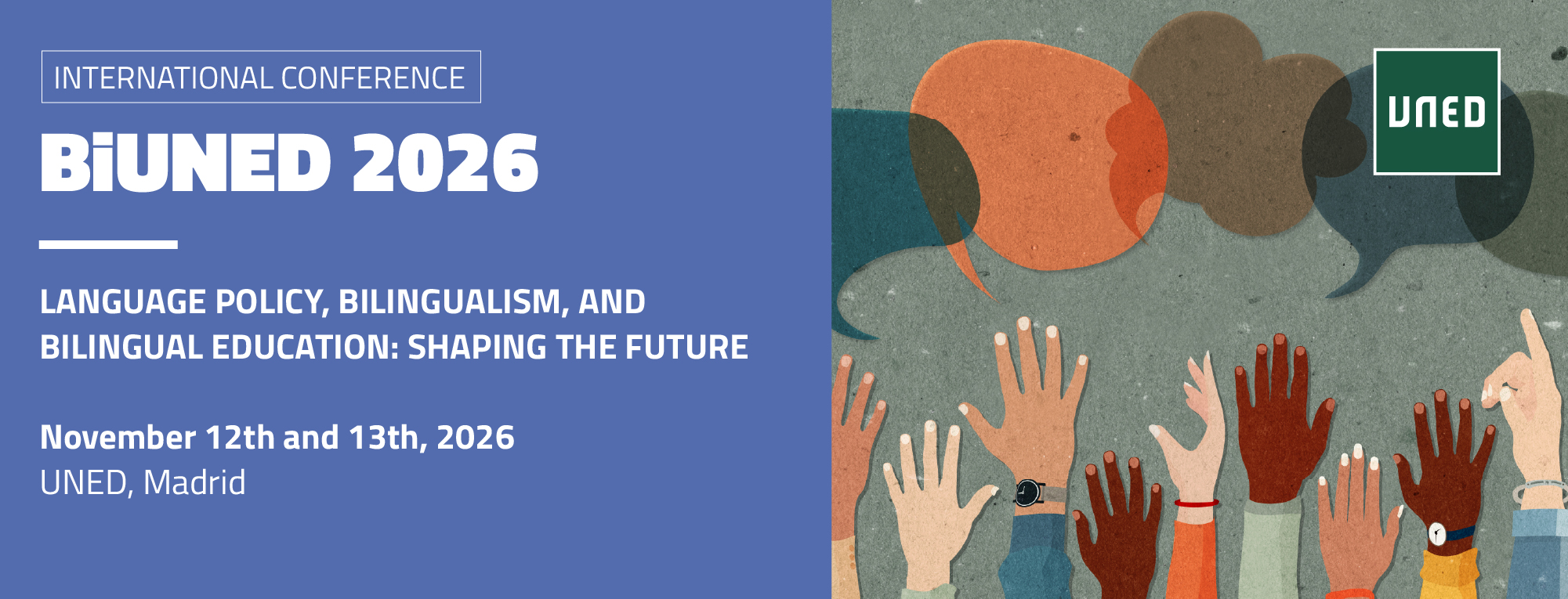
Since 2018, the UNED Language and Society Research Group has organised a series of biennial international conferences that have become a consolidated forum for scholarly debate on bilingualism and bilingual education. Building on previous editions that explored bilingualism and interculturality (2018), the relationship between bilingualism and migration (2020), the interplay between bilingualism, bilingual education, and their social contexts (2022), and how bilingualism and bilingual education intersect with political tensions and conflict (2024), BiUNED 2026 focuses on the role of past, present, and future language policies in shaping bilingualism and bilingual education worldwide.
In contemporary societies, bilingualism and multilingualism are no longer marginal phenomena. Global mobility, internationalised labour markets, digital communication, and rapid technological development, particularly artificial intelligence (AI) and data-driven technologies, are profoundly transforming how languages are learned, used, governed, and valued. These transformations affect not only educational practices but also research methodologies, assessment models, and language policy design. At the same time, language policies continue to generate tensions linked to ideology, identity, equity, linguistic rights, and access to education, which remain central concerns in European and international policy agendas.
Aligned with key priorities of the European Union, Horizon Europe, the European Education Area, and UNESCO, BiUNED 2026 aims to provide an international platform for critical, interdisciplinary, and forward-looking research on the intersections between language policy, bilingualism, and bilingual education across time, with particular attention to the impact of digital innovation and artificial intelligence on multilingual societies, educational systems, and governance frameworks.
Conference Themes (non-exhaustive)
- Language policy and language planning (past, present, and future)
• Bilingualism, multilingualism, and language ideologies
• Linguistic rights, equity, inclusion, and social justice
• Co-official languages and language governance
• Bilingual education policies and models (CLIL, EMI, immersion, translanguaging)
• Bilingualism, migration, and demographic change
• Heritage languages and family bilingualism
• English as a lingua franca and global multilingualism
• Interculturality, identity, and gender perspectives
• Sociolinguistics of language learning
• Artificial intelligence and digital innovation in language policy and bilingual education
• AI-supported teaching, learning, assessment, and research in multilingual contexts
• Ethical, critical, and sustainable approaches to AI in language education
• Digital equity, accessibility, and inclusion in bilingual and multilingual settings
Organising committee
Rubén Chacón Beltrán (coordinador). (UNED)
Montserrat Bermúdez Bausela (UNED)
María Josep Coderch Barrios (UNED)
Cecilia Criado de Diego (UNED)
Raymond Echitchi (Liege University)
Joseph García Rodríguez (UNED)
Diana Martínez Hernández (UNED)
Beatriz Pérez Cabello de Alba (UNED)
Mª Dolores Ramírez Verdugo (UNED)
Alicia San Mateo Valdehíta (UNED)
Scientific committee
Christián Abello Contesse (Universidad de Sevilla)
Juliane Da Costa (University of Cologne)
María Belén Díez Bedmar (Universidad de Jaén)
Ines Garcia Azkoaga (Universidad del País Vasco)
James Hawkey (University of Bristol)
Nils Langer (Europa-Universität Flensburg)
Luan Lee Ng (Universiti Malaya)
Cristóbal Lozano (Universidad de Granada)
Maureen McAlinden (British Council)
Francisco Moreno Fernández (Universität Heidelberg)
Ignacio Palacios Martínez (Universidad de Santiago de Compostela)
Mateusz Pietraszek (Universidad Complutense de Madrid)
Rogelio Ponce de León (Universidade do Porto)
Kim Potowski (University of Illinois, Chicago)
Fernando Ramallo (Universidad de Vigo)
Paolo Roseano (UNED)

SUBMISSION OF PROPOSALS
It is worth noting that the conference will be held in person, in Madrid. Presentations will last 20 minutes, followed by 10 minutes for discussion.
Participation is open to all researchers interested in the conference theme. Proposals for papers in English or Spanish are welcome.
Your proposal should include:
- A title (max. 15 words)
- Key words (max. 5 words)
- An abstract (300-400 words, not including references), followed by 5-10 references.
- A short biography (max. 200 words)
The deadline for the submission of proposals is 15 June 2026.
NOTIFICATION OF ACCEPTANCE
A written acceptance or refusal of proposals will be sent by e-mail no later than 6 July 2026.
Plenary Speakers
|
|
Elizabeth Lanza is Professor Emerita of Linguistics at the University of Oslo and former Director of the Center for Multilingualism in Society across the Lifespan (MultiLing) from its establishment in 2013 until her retirement at the end of 2021. She is an elected member of the Norwegian Academy of Science and Letters and was appointed as a Research Fellow at the Stellenbosch Institute for Advanced Study (STIAS) in South Africa the first semester of 2024. Title: Family Language Policies, Language Practices and Multilingualism in Shaping the Future Abstract: Contemporary globalization with new communication technologies and changes in the political and economic landscape have intensified transnational migration and interactions, with raising and educating children with more than one language becoming increasingly common. In my talk I will address new directions in the study of multilingual families, in the evolving field of family language policy – a sociolinguistic approach to the study of how families contribute to the multilingual child’s development and use of more than one language, drawing on theoretical frameworks of language policy, language socialization, literacy studies and child language acquisition. This study of multilingual families focuses on language ideologies and beliefs, language practices, language management and the impact this has on the development and use of heritage languages. Theoretically, the family has traditionally been considered a private domain that sets parameters for, and thus constrains, the choice of language(s) with family members within the space of the home. The notion of a domain and particularly of the family as a private domain can be critically challenged in light of theoretical approaches to the study of space. Space is conceived as dynamic and continually negotiated among various social actors with different discursive power, material constraints, and spatial practices. The issue of multilingualism is indeed highly embedded and entangled in society, community, neighborhood, school and family. Mediatized discourses can in fact construct the family as a public space, thus contributing to the (re)production of inequalities and power structures in society, which may impact children’s education. My focus is on the family as a locus for language learning and use; however, parents as language advocates and collaborators with educators will also be addressed, as family language policies meet educational language policies. This highlights the importance of bridging across family and formal education in shaping the future for a multilingual society. |

|
|
Michele Gazzola is Senior Lecturer (Associate Professor) in Public Policy and Administration at the School of Applied Social and Policy Sciences at the Ulster University (Northern Ireland), and editor-in-chief of the journal Language Problems & Language Planning. He has an interdisciplinary research profile focused on the analysis and evaluation of language policy, and on the study of the policy, economic and social aspects of multilingualism. Title: The Costs of Language Policy: Identification and Estimation Issues Abstract: The debate on language policies in education often, and rightly so, highlights the various benefits associated with bilingualism. To gain a comprehensive and balanced view, however, it is also necessary to consider the costs of language policies for society. Not all policies promoting bilingualism are the same. Language policy is a form of public policy that aims to influence the status, corpus and acquisition of languages through collective action planned and implemented, in part or in full, by public authorities. Every public policy necessarily requires the use of resources, which are never infinite, but always scarce and subject to alternative uses. Whilst the effectiveness of a language policy is measured primarily in terms of the benefits achieved, the efficiency of a language policy is measured on the basis of the cost-benefit ratio. This presentation analyses the concept of ‘cost’ and its application to the analysis of language policies. It shows that the costs of a language policy depend on the nature of the goods and services that the language policy produces. We will therefore present key concepts from public economics such as rivalry and excludability in consumption, the spatiality of goods, opportunity cost, and individuals’ willingness to pay, and we will examine their relevance to the cost analysis of language policies. The presentation includes examples of applications to educational language policies. An understanding of the complex nature of the different types of costs associated with language policies is necessary for a better-informed debate on the advantages and disadvantages of bilingualism. |

-
Deadline for abstract submission: Extended deadline: 25 June
-
Notification of abstract acceptance: 6 July 2026
-
Early-bird regsitration and payment: until 15 September 2026
-
Late registration and payment for speakers: from 16 September to 1 November 2026
-
Conference dates: 12 – 13 November 2026
(Attendee registration will be open until 11 November 2026)
Oral presenters:
Early-bird regstration and payment (until 15 September): €150
Late registration and payment (from 16 September): €190
Attendees:
Early-bird regstration and payment (until 15 September): €50
Late registration and payment (from 16 September): €80
You can register at the following link:
Registration
All conference participants with a paper presentation, should fill in the Registration form and pay the Registration fee not later than 1 November.
In case of co-authorship, any author who attends the conference and/or requires a certificate has to pay the registration fee
Reduced fee:
Doctoral students and presenters based in developing countries (Africa, Asia and Latin America) may apply for a 50 percent free waiver.
Certificates will be provided to enable oral presenters and attendees to evidence their participation in the conference.
Registration fees include access to coffee breaks, lunch and wine reception.
(In case of co-authorship, any author who attends the conference and/or requires a certificate has to pay the registration fee).
Past Conferences
2018: Bilingualism and interculturality: challenges, limits and solutions
2020: Bilingualism, Heritage Languajes and Migration
2022: Bilingualism and Bilingual Education: Sociolinguistic Approaches
2024: Bilingualism, Bilingual Education And Social (Sociolinguistic/Political) Conflict
Venue
Facultad de Educación de la UNED
Calle Juan del Rosal, 14
28040 Madrid
GETTING TO THE VENUE
TRANSPORTATION TO CAMPUS
METRO:
The metro is one of the easiest ways to reach the campus. The closest stop is “Ciudad Universitaria”, line 6. Then Line U (Avenida de Seneca – Paraninfo) This bus stops UNED.
BUS:
Line 133 is an easy way to reach the campus too. It leaves from the city center. The closest stop is “Veterinaria”, which is a six-minute walk away.
Line F, from “Plaza de Cuatro Caminos”. The closest stop is “Paraninfo – Informática”, which is a nine-minute walk away.
METRO + BUS
- Line 6 to “Ciudad Universitaria” + Bus “U”. This bus stops at “Paraninfo”, which is a two-minute walk away.
- Lines 3 or 6 to “Moncloa” + Bus «83», «133» or «162». These buses stop at “Avenida Puerta de Hierro”, which is a five-minute walk away.
- Lines 3 or 6 to “Moncloa” + Bus “G”. This bus stops at “Paraninfo – Informática”, which is a nine-minute walk away.
INTERCITY BUS
From “Moncloa” bus station you can take the following intercity buses: 601, 621, 622, 623, 624, 625, 627, 628, 629, 651, 651A, 652, 653, 654 y 655. The closest stop is “Avenida Puerta de Hierro Nº 3” next to the Faculty of Veterinary Medicine. You will find stairs that will directly take you to the conference venue. It is only a ten- minute walk.
Recommended accommodation
HOTELS NEAR THE CONFERENCE VENUE
Reservations: reservas@hotelexemoncloa.com
HOTEL PRINCESA PLAZA MADRID ****
Reservations: + 34 687 034 193
HOTEL MELIÁ MADRID PRINCESA *****
Reservations: melia.madrid.princesa@melia.com
LEONARDO MADRID CENTRE (HOTEL NH ALBERTO AGUILERA) ****
Reservations: info.madridcity@leonardo-hotels.com
HOTEL INDIGO MADRID PRINCESA***
Reservations: info@indigomadrid.com
HOTEL CITY HOUSE FLORIDA NORTE ****
Reservations: reservas.floridanorte@farandahotels.com
Reservations: aclosvascos@ac-hotels.com
SERCOTEL GRAN HOTEL CONDE DUQUE****
Reservations: reservas@sercotel.com
Reservas: hotelmadridgranvia@melia.com
SENIOR COLLEGES IN CIUDAD UNIVERSITARIA
COLEGIO MAYOR ARGENTINO NUESTRA SEÑORA DE LUJÁN
Reservations: administracion@cmanslujan.co